Tag: writing

  • Proofreading vs Copyediting vs Line Editing

    Thousands of editors have tried to explain the difference between the levels of editing. I’ve even done it myself, but I’ve long wanted to really show the differences between line editing, copyediting, and proofreading. (Developmental editing is a completely different beast—you can learn a little about it in this explanation of manuscript evaluations.) So I asked ChatGPT to write a story for me. It’s one of the few legitimate uses of generative AI I can justify—I knew it would be poorly written and would need work, and sharing it doesn’t violate the privacy of any of the authors I work with.

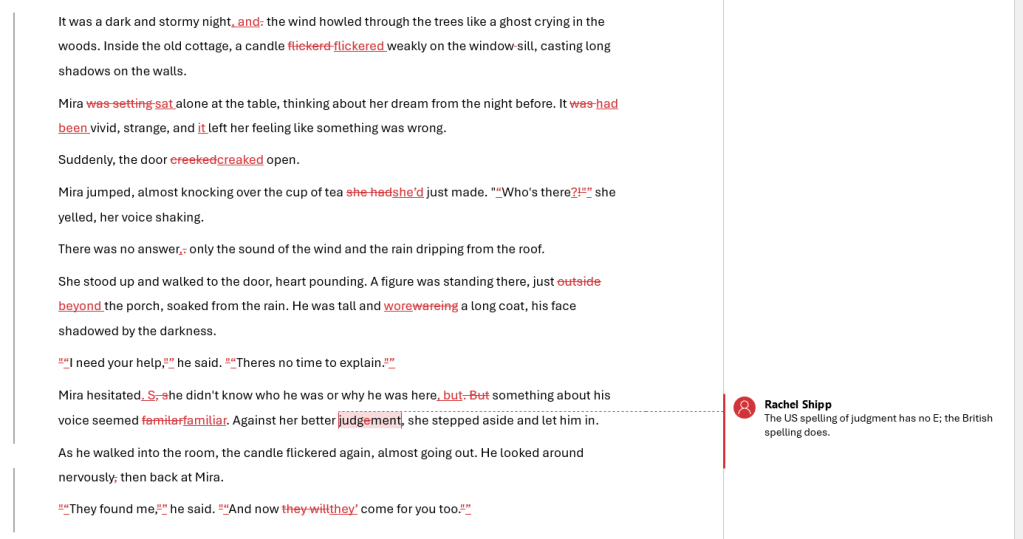
    In the following pictures, you’ll see marked-up versions of the story for each level of editing. At the end of this post, you can find the original story and the fully edited story.

    First up is proofreading. As you can see, the changes are very simple and focus mostly on spelling and punctuation corrections. Proofreading doesn’t fix your prose; it is only makes sure everything is correct and follows the style sheet.
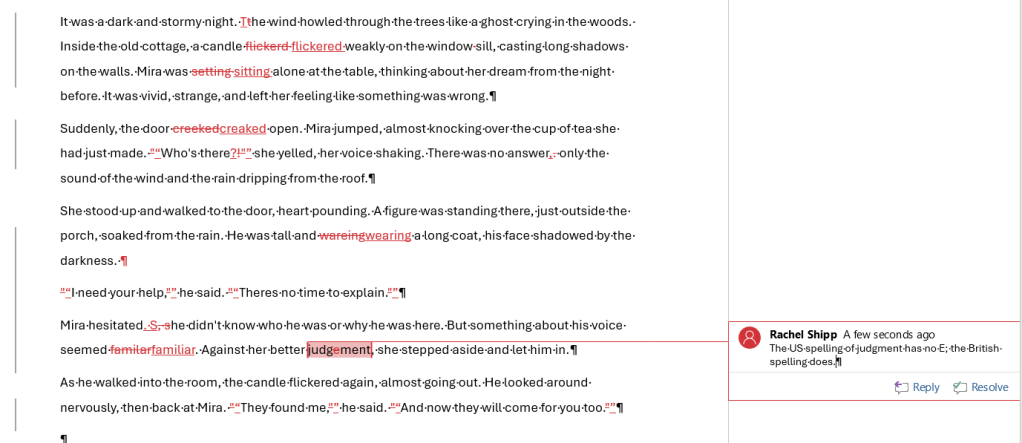
    Next is copyediting. You can see the same changes I made in the proofreading round, but I’ve also changed some of the words for a more active and exciting tone. In a longer text, copyediting would include making sure things are consistent throughout the manuscript—are you main character’s eyes gray, grey, or blue? Is the pirate ship always called Titan’s End or Titans’ End?

    Finally, this is my line edit of the story. Here, you can see where I’ve focused on the syntax and mood of the story. Along with changing the text, I’ve explained to the imaginary author how to add tension and avoid clichés. I also do a decent amount of fact checking in my line edits, but not every editor does.
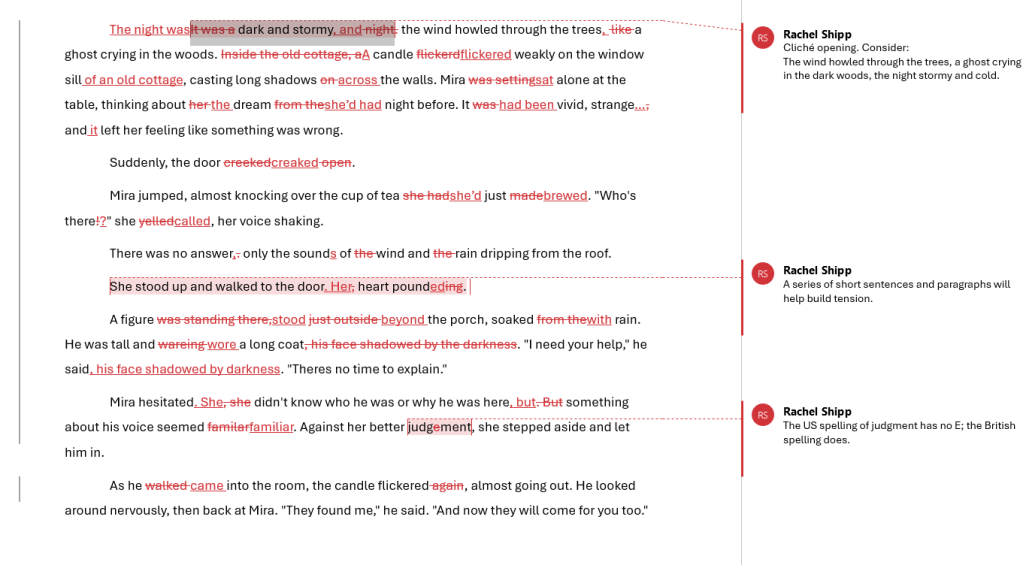
    As always, the lines between each of these levels are very blurry. I stopped offering separate services because I couldn’t stop myself from line editing every manuscript, no matter what service I’d been contracted for. As such, I do a little bit of them all between the two passes.

    If you choose to contract different editors for each step, start with the line editor and work backward—there’s no point in proofreading text that will have large changes made to it.

    Click here to learn more about my services. And as always, please contact me with any questions about anything you read on my website.

    For the sake of comparison, here is the original story as given to me by ChapGPT.

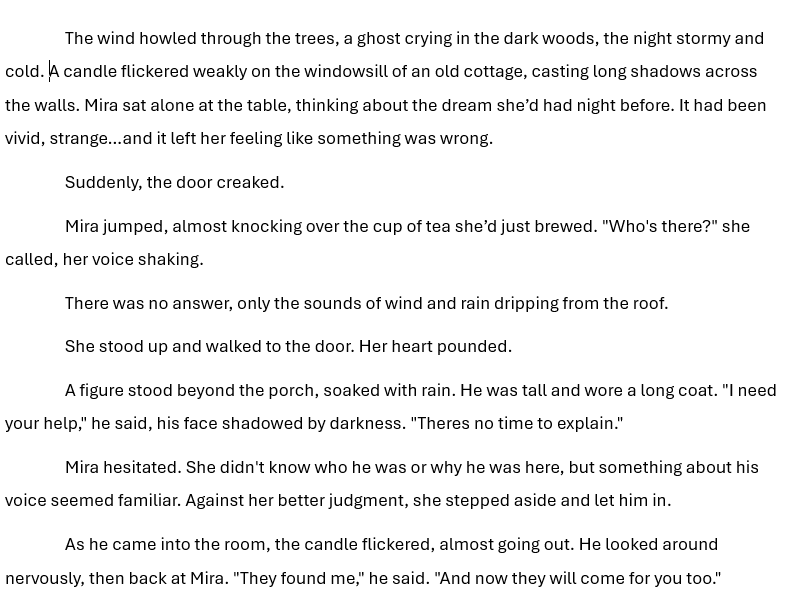
    And here’s the story after all my editing.
  • Writing is Actually About Reading

    Writing is Actually About Reading

    I’m going to tell you a secret: editing is largely subjective and there are fewer rules than you’ve been led to believe. I mean, there are rules and guidelines, but how to apply them is subjective. You can give five editors the same passage, and you’ll end up with five different final versions.

    And that’s okay.

    Because here’s another secret: writing a novel is really about reading.

    I’m going to repeat that because it’s so important.

    Writing a novel is about reading.

    How good or unique or clever your story is won’t matter if you have no one to read it, if you have no one who wants to read it. As the author, you want your reader to be engaged and interested in your story so they want to find out what happens next.

    And that’s where the rules and guidelines come into play. These rules help readers know what to expect. When a reader sees a quotation mark, they know a character is speaking. When a reader sees an apostrophe, they know it’s for a conjunction or to show possession. Knowing when and how to disregard the rules is as important as just knowing them—if there’s a period after only one word (an incomplete sentence), the reader will understand it’s an important word.

    And that brings me back to the first secret—editing is largely subjective. The changes I make in an author’s prose are not necessarily the same changes another editor would make, because editing is a collaborative process. An author writes a sentence, the editor makes a suggestion about how to improve the sentence, and the author decides whether the suggestion helps or hinders the message they’re trying to convey.

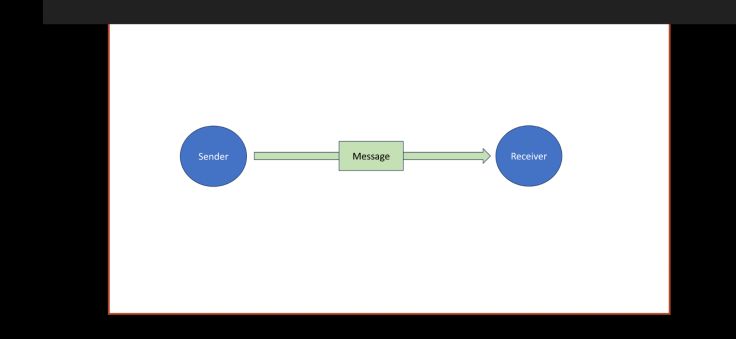
    Way, way back a long time ago when I was in college, we discussed a basic communication model in several classes (which made sense—I majored in mass communication). The basic idea is to have a sender, a receiver, and a message. The sender creates a message and sends it to the receiver, who interprets the message. In an ideal world, everybody is on the same page.

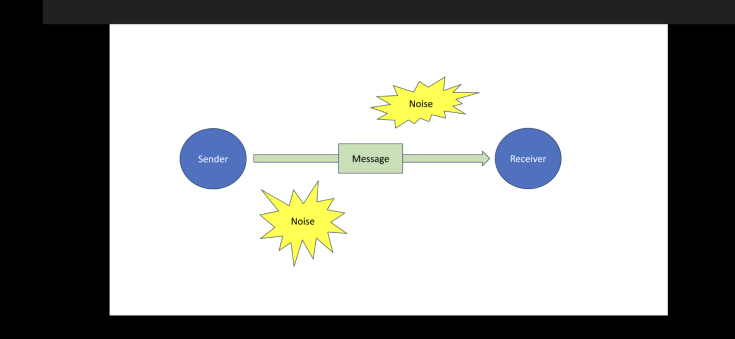
    The problem comes from not living in an ideal world. In the real world, each person comes to the message with their own knowledge and expectations—what we call noise here—and the message can be misinterpreted.

    Sometimes it’s because the sender assumes knowledge the receiver doesn’t have; sometimes it’s because the receiver has a weird bit of trivia the sender doesn’t have. The actual reason for the misinterpretation doesn’t matter. The problem is that there’s a misinterpretation at all.

    Which is why you hire an editor: to get rid of the noise—or as much noise as possible. Each editor is making sure the reader interprets the message the author is trying to send. It’s not just correcting commas and homonyms. I regularly ask authors “Does this sentence mean XX or YY?” or “Who is speaking here?” And I ask those things because I want your readers to love your story as much as you do. I want them to feel what your characters feel, to know what your characters know.

    When I’m working with a manuscript, I’m guided by this reader experience. I want to make sure your readers have the experience you want them to have, which means preserving your voice through every stage of the editing process. And that brings us back to editing as a subjective thing. If any editor is changing your message too much, then that editor isn’t the right fit for you (though they may be for someone else).

    If you have any questions about this or anything else you’ve read here, please feel free to reach out to me at any time.